
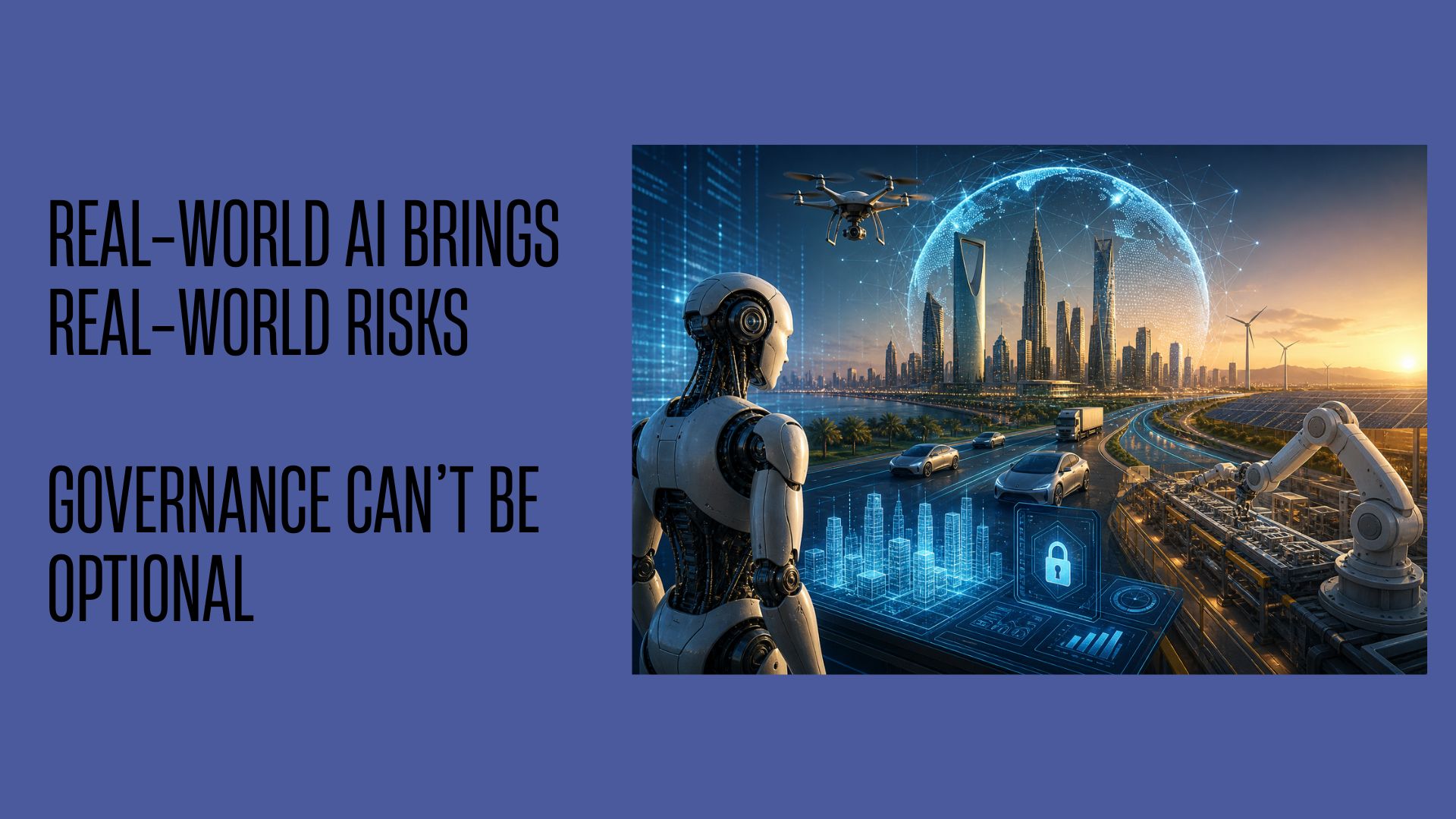
Artificial intelligence is stepping out of the digital world. For decades, AI has lived inside data centers, analyzing data, generating content, and predicting outcomes. As powerful as it was, it remained disconnected from the physical environment.
That boundary is now disappearing. We are entering the era of Physical AI, where machines can sense their surroundings, understand how the world works, and act in real time. From robots to autonomous systems, AI is no longer limited to processing information.
It is beginning to shape the real world.
What is Physical AI?
Physical AI refers to artificial intelligence embedded in physical machines, such as robots, vehicles, and industrial equipment, that can sense their environment, make decisions, and act in real time.
These systems use cameras, LiDAR, and tactile sensors, combined with models that understand movement, space, and object interaction. Unlike traditional digital AI that works on stored or static data, Physical AI operates in constantly changing environments and must adapt continuously.
Why Physical AI Changes Privacy and Governance
Physical AI operates directly in the real world, generating continuous streams of sensitive data. Sensors capture detailed information about people, movements, objects, and behaviors in real time, creating monitoring risks far beyond traditional digital systems.
It also raises new accountability questions. When a robot causes harm or an automated system makes an incorrect decision, responsibility is no longer straightforward. It may involve the developer, the deploying organization, and the hardware provider.
At the same time, the always-on nature of sensors makes meaningful consent difficult. Individuals often cannot opt out of being recorded in public or workplace environments. Data ownership becomes more complex when information flows across borders and multiple stakeholders.
Physical AI transforms how systems operate, but also how risks emerge. Governance must evolve from reactive compliance to proactive design.
Without strong governance, Physical AI risks scaling harm as quickly as it scales innovation.
Saudi Arabia’s AI Push: HUMAIN and National Infrastructure
Saudi Arabia is making a significant move into Physical AI. Through HUMAIN, a Public Investment Fund-backed company, the Kingdom entered a strategic partnership with NVIDIA in May 2025.
HUMAIN is building AI factories with up to 500 megawatts of capacity, powered by hundreds of thousands of advanced NVIDIA GPUs over the next five years. The first phase includes an 18,000-unit NVIDIA GB300 Grace Blackwell supercomputer supported by high-speed InfiniBand networking.
This investment reflects a broader push toward AI sovereignty, where nations seek control over their computing power, data, and technological infrastructure. It also positions Saudi Arabia among a small group of countries investing in AI at infrastructure scale, not just at the application level.
HUMAIN is deploying NVIDIA Omniverse to build high-fidelity digital twins across manufacturing, logistics, energy, and urban systems. Large-scale training initiatives are also underway to equip Saudi professionals with practical experience in AI, simulation, robotics, and digital twin technologies, supporting the goals of Saudi Vision 2030.
Alongside major infrastructure investments, HUMAIN and NVIDIA are also focusing on large-scale upskilling initiatives to build talent for a Physical AI economy. These programs aim to equip thousands of Saudi professionals with practical experience in AI, robotics, simulation, and digital twin technologies, supporting the Kingdom’s broader goals under Saudi Vision 2030.
As Jensen Huang highlighted, AI is becoming essential infrastructure, similar to electricity and the internet; while Tareq Amin, CEO HUMAIN emphasized that the partnership is not only about building systems, but also developing long-term capability and a globally competitive ecosystem.
Governance, Risk & Compliance: The Critical Imperative
Saudi Arabia’s scale of ambition makes governance even more critical. Sensor networks and digital twin environments will generate large volumes of personal and behavioral data.
Key risks include:
- Continuous monitoring: Sensors in workplaces and public spaces can create detailed behavioral profiles
- Data ownership: Determining who owns and controls data, especially across jurisdictions, remains complex
- Consent challenges: Individuals often cannot meaningfully opt out in shared environments
- Accountability: When systems fail, responsibility must be clearly defined
Unlike traditional digital AI, failures in Physical AI can lead to real-world physical harm, not just data breaches.
This makes governance a core requirement, not an afterthought. Organizations must embed privacy assessments, ethical review processes, and transparent data practices into every stage of deployment.
What Organizations Must Do Now
As Physical AI moves into real-world deployment, governance can no longer remain reactive. Organizations must take early, structured action:
- Conduct Privacy Impact Assessments and Data Protection Impact Assessments for all deployments
- Embed privacy-by-design and security-by-design from the outset
- Define clear data governance frameworks covering ownership, retention, and sharing
- Establish human oversight mechanisms for autonomous systems
- Engage with evolving regulatory requirements
- Build cross-functional teams across legal, technical, and operational domains
Conclusion
Physical AI is no longer a future concept. It is being deployed at scale today, as Saudi Arabia’s HUMAIN initiative clearly demonstrates. The opportunities for innovation and efficiency are significant, but so are the risks.
Organizations and governments that treat governance as a strategic foundation, not a compliance checkbox, will lead responsibly in this new era.
The question is no longer whether Physical AI will grow, but whether governance will evolve fast enough to keep it safe, accountable, and trusted.
_______________________________________________________________________
As Physical AI continues to expand across industries, organizations must proactively strengthen their privacy and governance frameworks. For expert guidance on navigating these challenges and building compliant, future-ready systems, reach out to PrivacyPulse for tailored advisory and support.