
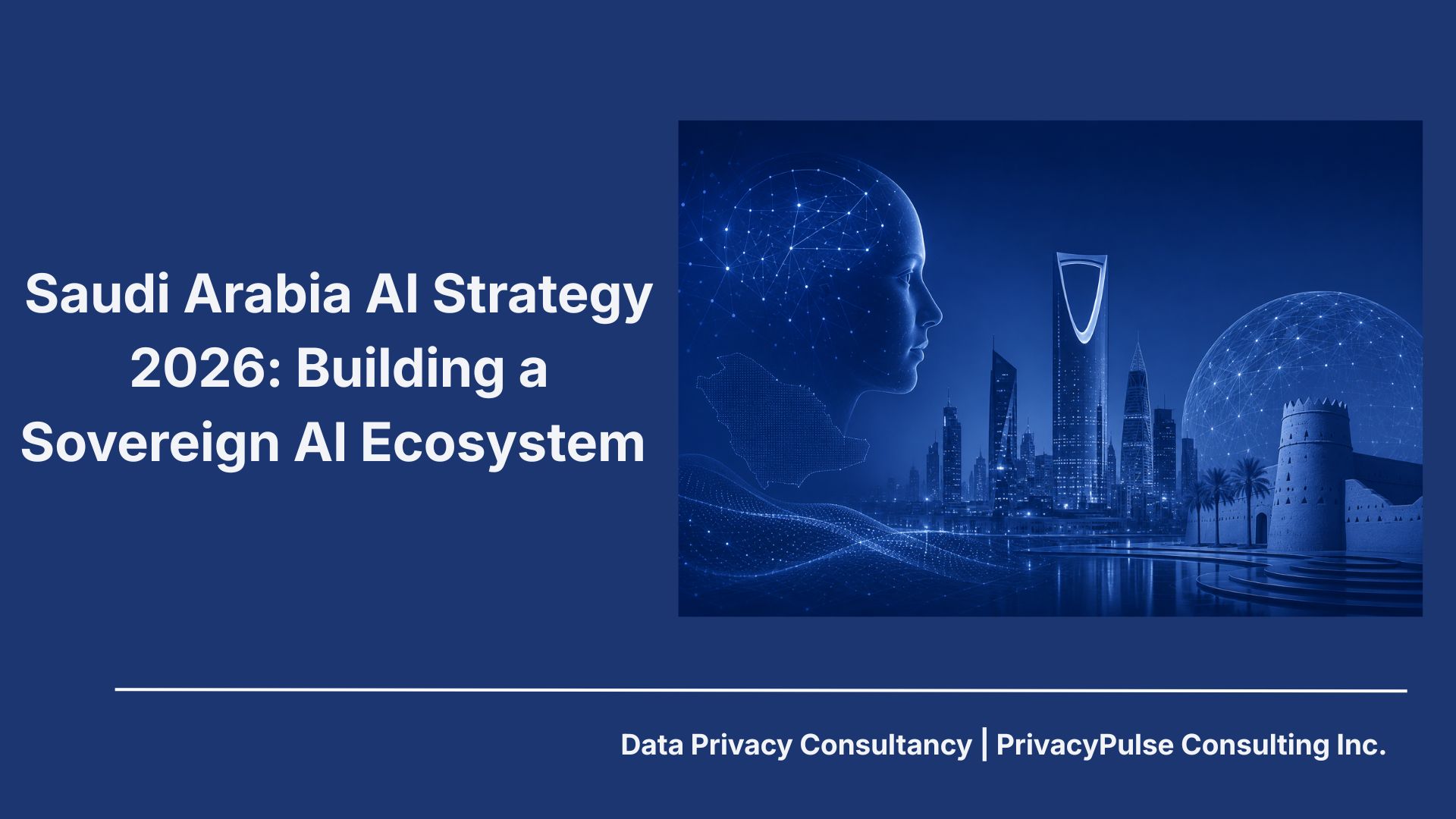
Saudi Arabia’s AI strategy is no longer simply about adopting artificial intelligence. The Kingdom is building the infrastructure, talent, research capabilities and data ecosystem needed to develop and deploy AI at national scale. Under Saudi Vision 2030 and the designation of 2026 as the Year of Artificial Intelligence, supported by government strategy, corporate investment and academic research to create a comprehensive national AI ecosystem.
For organisations operating in or entering the Saudi market, this transformation creates both opportunity and responsibility: access to a rapidly expanding Saudi AI ecosystem on one side, and growing considerations around data privacy, cybersecurity and responsible AI on the other.
2026: The Year of Artificial Intelligence in Saudi Arabia
In March 2026, the Council of Ministers approved the designation of 2026 as the Year of Artificial Intelligence. The initiative reflects Saudi Arabia’s growing focus on accelerating AI adoption, developing national talent and increasing awareness of AI’s economic and social potential.
The initiative also reinforces the role of artificial intelligence in Saudi Arabia’s broader Vision 2030 agenda, particularly in economic diversification, digital transformation and the development of a knowledge-based economy.
For businesses, the significance is clear. AI is increasingly moving from an emerging technology discussion to a strategic priority that can influence investment, infrastructure, workforce development and competitiveness across the Saudi economy.
Government AI Strategy: The Role of SDAIA
The Saudi Data and Artificial Intelligence Authority (SDAIA), established in 2019, serves as Saudi Arabia’s national authority for data and artificial intelligence. It leads the National Strategy for Data and AI (NSDAI), which seeks to strengthen Saudi Arabia’s position in the global AI landscape, develop specialised talent, establish an enabling regulatory environment and attract investment in data and AI.
Key initiatives include large-scale talent programmes such as SAMAI, training through the SDAIA Academy, and efforts to expand AI skills across education and the workforce.
Infrastructure projects, including the Hexagon Data Centre in Riyadh, also reflect Saudi Arabia’s focus on developing advanced computing and data infrastructure to support AI and digital transformation.
SDAIA has additionally developed AI ethics principles and other governance and risk-management initiatives aimed at supporting responsible AI adoption.
Together, these government-led initiatives provide the strategic direction, skills, governance and infrastructure foundations within which Saudi Arabia’s private-sector AI capabilities can develop.
HUMAIN and Saudi Arabia’s Corporate AI Ecosystem
At the centre of Saudi Arabia’s corporate AI ambitions is HUMAIN, launched in 2025 under the Public Investment Fund (PIF). HUMAIN is designed as a full-stack AI company spanning data centres, cloud capabilities, generative AI models and AI applications.
The company has announced plans for large-scale AI infrastructure and partnerships with global technology providers, including Amazon Web Services (AWS), NVIDIA, AMD, Qualcomm and Saudi Telecom Company (stc).
One important focus is Arabic-language artificial intelligence, including the development of ALLaM, an Arabic-first multimodal AI model. This reflects a strategic interest in developing AI systems that are better adapted to Arabic language, culture and regional requirements.
The concept of sovereign AI is central to this broader transformation. In simple terms, sovereign AI refers to a country’s ability to develop and maintain greater control over critical AI capabilities, including computing infrastructure, data, models, talent and technological capacity.
Beyond HUMAIN, AI adoption is expanding across strategic sectors in Saudi Arabia. Energy companies are exploring AI for predictive maintenance and operational optimisation. Financial institutions are applying AI to areas such as fraud detection, risk management and customer services. Telecommunications providers are expanding AI-enabled infrastructure and enterprise solutions, while healthcare and smart-city initiatives are exploring applications ranging from diagnostics to urban services.
The broader trend is becoming clear: Saudi Arabia is developing national AI infrastructure and capabilities while businesses across strategic sectors begin turning those capabilities into practical commercial applications.
KAUST and KFUPM Academic AI Research in Saudi Arabia
A successful AI strategy in Saudi Arabia cannot be built through government policy and corporate investment alone. It also requires universities and research institutions capable of developing new technologies, training specialised talent and translating research into practical applications.
The King Abdullah University of Science and Technology (KAUST) plays a prominent role through its Center of Excellence for Generative AI. The centre focuses on advancing generative AI research and exploring applications aligned with strategic priorities such as health, sustainability, energy and future economies.
Its work contributes to Saudi Arabia’s AI research capabilities while supporting the talent pipeline required for a growing AI economy.
Other institutions, including King Fahd University of Petroleum and Minerals (KFUPM) through research collaborations with SDAIA, also contribute to applied AI research and workforce development.
Together, these initiatives help create a pipeline connecting AI research, talent, innovation and commercialisation; an essential foundation for Saudi Arabia’s long-term AI ambitions.
What Saudi Arabia’s AI Strategy Means for Business Leaders
For CEOs, CFOs and business leaders, AI investment involves more than selecting technology. Organisations must assess infrastructure, data readiness, cybersecurity, vendor contracts, intellectual property, employee capabilities, privacy compliance and ongoing AI governance.
Key questions include: Where is the AI system hosted? Where is data processed? Who controls the data and AI outputs? Can personal or confidential information be used for model training? What happens to data when the vendor relationship ends? What subprocessors are involved? What security, audit and compliance rights exist?
Businesses that treat AI as a strategic capability, rather than simply a technology investment will be better positioned to capture value while managing operational and regulatory risk.
Final Thoughts
Saudi Arabia is moving beyond AI adoption towards building a sovereign AI ecosystem that connects national policy, corporate innovation, academic research and advanced technology.
As this transformation accelerates, data privacy and AI governance become equally important. Saudi Arabia’s Personal Data Protection Law (PDPL) provides the primary framework for personal data processing, requiring organisations to carefully consider data use, storage, access, AI training, third-party vendors and cross-border transfers. SDAIA’s AI ethics and governance initiatives further reinforce responsible AI adoption.
Sustainable AI leadership will depend not only on technological advancement, but also on responsible data governance, cybersecurity and trust. Businesses that balance innovation with compliance will be best positioned to succeed.
_______________________________________________________________________
Looking to strengthen privacy governance and compliance capabilities? PrivacyPulse helps organisations and professionals build practical expertise in privacy management and data protection.
Reference
- Council of Ministers: Decision 720 Approving the Naming of the Year 2026 as the “Year of Artificial Intelligence” – Decree
- SDAIA | National Data & AI Strategy | Saudi Arabia SDAIA
- SDAIA | About SDAIA | Saudi Data & AI Authority Overview
- HRH Crown Prince launches HUMAIN as global AI powerhouse
- https://www.ishgfesfe.humain.ai/en/news/humain-chat-launch/
- Physical AI: From Digital Intelligence to Embodied Action – Governance, Risk, and Saudi Arabia’s Strategic Leap | Privacy Pulse
- https://www.datacenterdynamics.com/en/news/saudi-arabias-new-ai-venture-humain-teams-up-with-aws-for-5bn-ai-zone/
- SDAIA-KFUPM Joint Research Center for Artificial Intelligence – King Fahd University of Petroleum & Minerals
- Saudi Arabia’s Hexagon Data Center: Foundation Stone Laid in Riyadh | Privacy Pulse
- ai-principles.pdf